
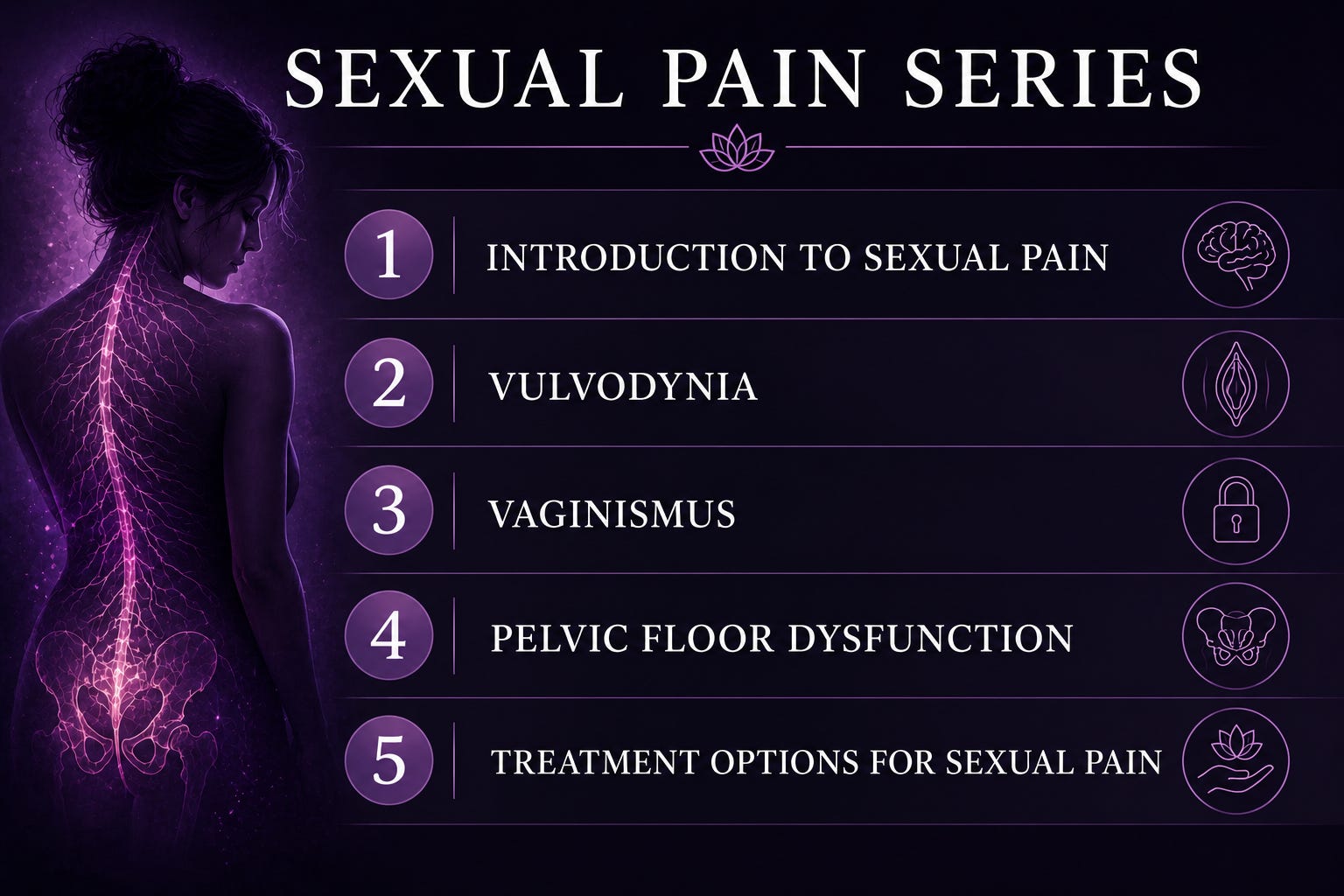
This is the fourth article in a five-part series examining sexual pain and the conditions that commonly contribute to painful intimacy.
Previous articles explored vulvodynia and vaginismus, two conditions that frequently overlap with another often-overlooked contributor: pelvic floor dysfunction. While patients may assume their symptoms originate from the vulva or vagina alone, the muscles supporting the pelvis frequently play a central role in both the development and persistence of sexual pain.
This article examines pelvic floor dysfunction, how it develops, why it is commonly missed, and the ways in which muscular tension can influence everything from intercourse to urination, bowel function, posture, and chronic pain.
The Muscles You Never Think About
The pelvic floor is one of the least appreciated muscle groups in the human body. Most people can identify their biceps, quadriceps, or abdominal muscles, yet few can describe the muscles that support the bladder, rectum, reproductive organs, and core. Despite this lack of awareness, the pelvic floor works continuously throughout the day, helping coordinate everything from urination and defecation, to posture, movement, and sexual activity.
Under ideal circumstances, the pelvic floor behaves much like any other muscle group. It contracts when support is needed and relaxes when appropriate. Problems arise, therefore, when that balance is lost. Some individuals develop weakness and poor support, while others develop excessive tension, guarding, and chronic spasm. It is this latter group that is particularly relevant to sexual pain.
One useful analogy is to imagine walking around with your shoulders shrugged toward your ears all day long. Initially, you might notice mild tension. After weeks or months, however, pain, stiffness, headaches, and restricted movement would likely develop. The same principle applies to the pelvic floor. Muscles that remain chronically contracted eventually become painful, irritable, and dysfunctional.
Unfortunately, because these muscles are hidden from view, patients often have no idea they are tightening them. The resulting symptoms may be attributed to infections, gynecologic disease, aging, or stress, while the underlying muscular contribution remains undiagnosed.
How Pelvic Floor Dysfunction Develops
One of the most challenging aspects of pelvic floor dysfunction is that patients rarely identify a single causative event. Unlike a broken bone or surgical incision, there is often no obvious beginning. Instead, dysfunction typically develops gradually through the accumulation of multiple influences over time.
Pain, understandably, is one of the most common contributors to pelvic floor dysfunction. As discussed in previous articles, painful stimuli trigger protective muscular guarding. When this guarding becomes repetitive, the pelvic floor may remain partially contracted even after the original pain source has resolved. Over time, the nervous system begins treating this tension as the new normal.
Trauma, childbirth, pelvic surgery, athletic injury, even chronic constipation, and urinary dysfunction have all been associated with contributing to pelvic floor dysfunction. Psychological stress may also play a role, as many individuals unconsciously hold tension in the jaw, shoulders, or neck. Others (such as yours truly) hold it in the pelvic floor. The body does not necessarily distinguish between emotional and physical stress when generating muscular tension.
The result is a self-reinforcing cycle. Tight muscles generate pain. Pain triggers further guarding. Guarding creates additional tension. Eventually the patient may develop symptoms despite having no ongoing tissue injury whatsoever.
What Pelvic Floor Dysfunction Looks Like for Patients
One reason pelvic floor dysfunction is frequently missed is that its symptoms appear unrelated on the surface. Patients may present complaining of painful intercourse, may also have urinary urgency, while those with constipation may also present with difficulty sitting, or a vague sense of heaviness within the pelvis. Few realize these seemingly separate complaints may originate from the same muscular system.
In the context of sexual medicine, pain during penetration is one of the most common presentations. Patients often describe a dull, aching, stretching, or pressure-like sensation rather than the burning pain commonly associated with vulvodynia. Deep penetration may reproduce discomfort when contracted muscles are compressed during intercourse.
Many patients also report that certain positions are more tolerable than others. Others describe difficulty relaxing during intimacy or a sensation that their pelvis feels “tight” or “locked.” Some notice that their symptoms worsen during periods of stress, fatigue, or emotional distress.
Perhaps most tellingly, pelvic floor dysfunction rarely limits itself to sexual activity alone. The presence of some of the above-named symptoms often provide valuable clues that the problem extends beyond the reproductive organs themselves.
Diagnosing the Problem
Diagnosing pelvic floor dysfunction requires looking beyond traditional gynecologic pathology. Unfortunately, many patients will undergo extensive evaluations for infection, hormonal disorders, or even other conditions such as endometriosis before anyone assesses the pelvic floor itself. Yet in many cases, the answer is literally sitting beneath the surface.
In this case, a physical examination is essential. Assessment begins with observation of posture, gait, breathing patterns, and pelvic mechanics. The pelvic floor muscles can then be evaluated through targeted examination, allowing the clinician to identify areas of tenderness, spasm, weakness, or poor coordination.
One of the most validating moments for patients often occurs when their familiar pain is reproduced during examination. For years they may have been told nothing is wrong because imaging studies were normal. Suddenly, a specific muscle is identified that recreates exactly the discomfort they experience during intercourse. The pain becomes tangible and explainable.
At Haven Center, evaluation of the pelvic floor is a routine component of sexual pain assessment. It is not uncommon to discover that what initially appeared to be vulvodynia, vaginismus, bladder pain, or dyspareunia also involves a significant muscular component. Identifying that component often changes the treatment plan dramatically.
So, How Do We Restore Function?
The encouraging aspect of pelvic floor dysfunction is that it is often highly treatable once recognized. Unlike many chronic pain conditions, patients frequently experience meaningful improvement when muscular dysfunction is addressed directly.
As with many other aspects of sexual pain, pelvic floor physical therapy remains a cornerstone of treatment. Through a variety of modalities, including manual therapy, biofeedback, stretching, and neuromuscular reeducation, patients learn to recognize and release chronic tension patterns that may have existed for years. For many, simply becoming aware of their pelvic floor is the first step toward recovery.
Additional therapies may include muscle relaxants, lifestyle modification, counseling, and management of contributing bowel or bladder conditions. In selected patients with severe muscular spasm, chemodenervation with onabotulinumtoxinA (Botox) may provide significant benefit by interrupting long-standing guarding cycles.
At Haven Center, pelvic floor dysfunction is one of the most frequently encountered contributors to sexual pain. What makes the condition particularly fascinating is that it often exists at the intersection of neurology, musculoskeletal medicine, psychology, and sexual health. Successful treatment therefore requires more than simply relaxing a muscle, it requires helping the nervous system abandon a protective pattern it no longer needs.
In the final article of this series, we will bring these concepts together and examine treatment strategies for sexual pain more broadly. By this point, a common theme should be emerging: pain is rarely the result of a single structure or diagnosis. More often, it is the product of multiple interconnected systems that must be understood before they can be effectively treated.
© 2026 Corey R. Babb, DO, FACOOG, IF, MSCP. All rights reserved.