
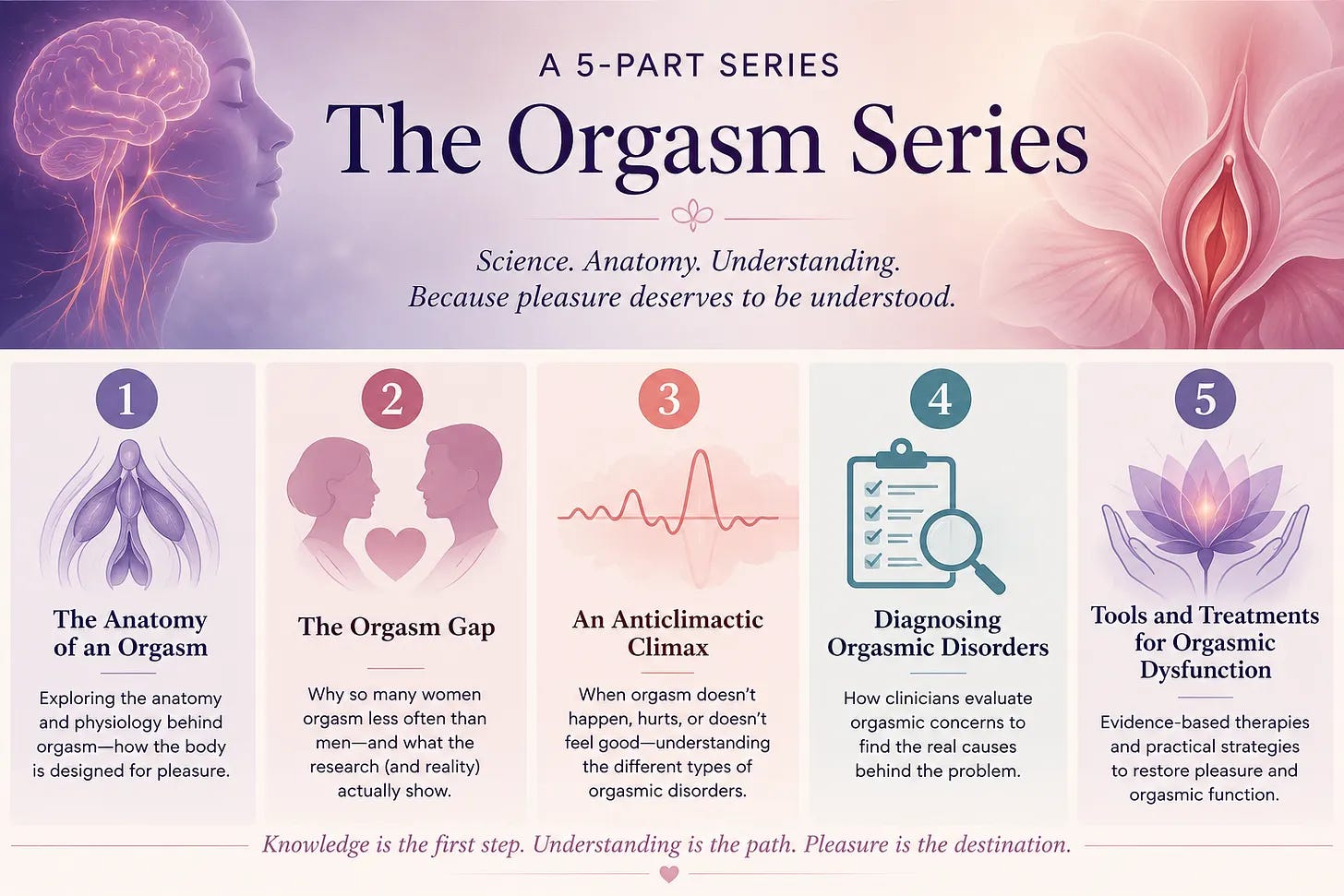
This is the fourth article in a five-part series exploring orgasm, orgasmic dysfunction, and the science of sexual pleasure.
Last week, we discussed the many ways having an orgasm can fail. Some women never experience an orgasm despite adequate stimulation. Others lose the ability over time. Some experience painful orgasms, while others describe the physical events of climax occurring without the accompanying sensation of pleasure.
Although these experiences may appear similar on the surface, they often arise from very different physiologic processes.
“Can You Tell Me What’s Wrong?”
A patient in her mid-fifties presented several months after entering menopause.
“I still enjoy sex,” she explained. “I still become aroused. I just can’t seem to get there anymore.”
She wondered whether she needed hormones.
Another patient had described a nearly identical symptom several weeks earlier.
“I can have an orgasm by myself,” she had explained, “but never with my husband.”
She wondered whether she needed therapy.
A third patient described something different entirely.
“The orgasm happens,” she said, “but it doesn’t feel good anymore.”
She wondered whether something had happened to her nerves.
Three patients, with three very similar complaints, and three entirely different diagnostic pathways.
That distinction sits at the center of sexual medicine.
The goal is not simply identifying that obtaining an orgasm has become difficult. The goal is determining why.
The Most Important Question in Sexual Medicine
Patients are often surprised by how quickly the conversation turns toward masturbation.
After all, they arrived because they were having difficulty obtaining an orgasm with a partner. Why would a clinician immediately ask about what happens when they are alone?
Because few questions provide more diagnostic information.
A patient who can reliably achieve an orgasm during masturbation but not during partnered intercourse follows a very different diagnostic pathway than a patient who has never experienced an orgasm under any circumstance. Likewise, a woman who suddenly loses the ability to climax after beginning an antidepressant presents a very different clinical picture than someone who gradually notices worsening orgasmic function during menopause.
Viewed through this lens, sexual medicine begins to resemble detective work more than laboratory medicine. The symptom may sound identical, but the pattern often tells the story.
Consider a few examples.
A patient who can achieve an orgasm alone but not with a partner frequently points us toward differences in stimulation, arousal, communication, distraction, or sexual technique rather than a hormonal or neurologic disorder. This finding is extraordinarily common and, in many cases, reassuring. The physiology necessary for orgasm is clearly present. The challenge lies elsewhere.
Conversely, a patient who previously obtained orgasms easily during both masturbation and partnered sexual activity but suddenly loses that ability after starting sertraline immediately raises suspicion for medication-induced dysfunction. The timeline itself becomes diagnostic information.
A patient who reports progressive difficulty obtaining an orgasm during the menopausal transition may point us toward declining estrogen levels, diminished genital blood flow, genitourinary syndrome of menopause, or changes in androgen signaling. Again, the symptom sounds familiar, but the physiology may be entirely different.
Perhaps the most challenging patient is the woman who has never experienced an orgasm despite adequate desire, arousal, and stimulation. Lifelong orgasmic dysfunction requires a different conversation altogether, one that may include anatomy, neurodevelopment, sexual education, psychological factors, and relationship history.
This is why sexual medicine specialists spend so much time asking questions that initially seem unrelated to the symptom itself.
Have you ever had an orgasm?
Was it with a partner, alone, or both?
Did something change?
Was the change sudden or gradual?
Was there a new medication, surgery, illness, or life event?
Is the problem universal or situational?
Patients often arrive expecting blood tests or imaging, but more often, the diagnosis begins with a conversation.
In sexual medicine, the history is frequently the most important diagnostic tool we possess.
Hormones, Medications, and Medical Conditions
One of the most common misconceptions surrounding orgasmic dysfunction is that obtaining an orgasm should be largely automatic once adequate stimulation occurs. In reality, having an orgasm depends upon the successful coordination of multiple systems simultaneously: vascular, neurologic, endocrine, muscular contraction, and central nervous system processing all contribute to the experience of climax. When one of those systems changes, orgasmic function may change as well.
Hormones are often among the first factors clinicians consider, particularly when symptoms arise during major reproductive transitions, such as the postpartum period, while breastfeeding, or during menopause. Estrogen plays an important role in maintaining genital blood flow, lubrication, tissue elasticity, and sensory responsiveness, and testosterone appears to contribute to sexual motivation, arousal, and orgasmic intensity in at least some women. Alterations in these hormonal environments may influence the ability to achieve an orgasm even when desire remains intact.
Medications deserve equal attention. Selective serotonin reuptake inhibitors (SSRIs) remain among the most common causes of acquired orgasmic dysfunction encountered in clinical practice. Patients often describe a peculiar phenomenon in which sexual desire remains relatively normal and arousal still occurs, yet orgasm becomes delayed, diminished, or impossible to achieve. For many, the sensation is less one of absence than disconnection, as though the body can approach climax but cannot quite cross the finish line.
Other medications may contribute as well. Serotonin-norepinephrine reuptake inhibitors, antipsychotics, antihypertensives, opioids, and even some antihistamines have all been implicated in sexual dysfunction. The challenge is that patients frequently attribute these changes to aging, stress, or relationship difficulties rather than considering the possibility of medication side effects. The timing of symptom onset therefore becomes critically important.
Likewise, medical conditions themselves may also interfere with orgasmic function. Diabetes may impair the vascular and neurologic pathways required for sexual response, while pelvic surgery, spinal cord injuries, and other neurologic disorders may disrupt the transmission of sensory information between the pelvis and the brain. Chronic illnesses such as high blood pressure or coronary artery disease may reduce genital blood flow in much the same way they affect other organ systems.
Importantly, these contributors rarely exist in isolation. A menopausal patient may simultaneously be taking an SSRI while managing diabetes and recovering from pelvic surgery. A postpartum patient may be navigating low estrogen levels, sleep deprivation, breastfeeding, and the demands of caring for a newborn. Sexual medicine rarely involves identifying a single culprit. More often, it involves understanding how multiple physiologic changes intersect to produce a symptom.
This complexity can be frustrating for patients hoping for a single explanation. At the same time, it is often reassuring. Difficulty obtaining an orgasm is rarely evidence that someone is broken (shout out to Kelly Casperson, MD ). More often, it reflects the fact that sexual function is exquisitely sensitive to changes occurring throughout the body. The challenge is not proving that something is wrong. The challenge is identifying which system is asking for attention.
Which leads us to, the physical exam.
